Tuesday, May 27, 2014

Unhappy employees are bad for your business

According to data compiled by Bolt Insurance, a whopping 80 percent of employees are dissatisfied with their jobs in some way. And when that dissatisfaction gets so high that employees jump ship, it can cost an average of one fifth of the employee's salary to find a replacement, not to mention the loss in productivity.
This infographic shows the industries with the highest turnover rates and what businesses can do to keep their employees more engaged in their work.

To me, beyond the monetary cost to replace an employee who has left the company, the disastrous and non-quantifiable consequences of unhappy employees are essentially a loss in productivity, a poor delivery of customer/brand experience, and ultimately a loss in the inner innovation power of the organization.

According to an analysis conducted by the Gallup Organization disengaged employees cost the American economy up to $350 billion a year due to lost productivity, because they are the lowest performing. To put it simply, if there had been engaged workers in those positions, they could have been far more productive.
Employee unhappiness can drag a company's image down. Take the example of Walmart. 
I guess it depends on the person, but I think that we can all agree that in general - perhaps with the exception of the elderly greeters - most Walmart employees don't seem particularly passionate about their jobs. I don't think I'm being unfair by saying that. Some even seem to really, really, really hate their job. I'm not judging, and I am not saying that Walmart employees should act as happy as Starbucks baristas... I can't help but wonder why they don't. Does Starbucks pay that much better than Walmart? Is serving coffee all day that much more fun than stocking or scanning stuff? Is there really that much of a difference? Is it just that working at Starbucks is cool but working at Walmart isn't? Are a person's identity and sense of self worth tied-in with the image of the company they work for? (If Starbucks is cool, then working at Starbucks makes me cool? If Walmart sucks, then working for Walmart means I suck?) Maybe, I don’t know for sure. I guess I could see a little kid wanting to grow up to be a barista: they make coffee, the coffee makes people happy, so it isn't a bad job. I don't know too many kids who would ever find working register 12 at Walmart fun or cool or rewarding.
Obviously, Walmart has an image problem, and the entire company's identity may be caught in a self-perpetuating vicious cycle of substandard customer-to-brand experiences.
Unhappy employees can turn even the best companies into "have beens". In contrast, happy employees can turn even the most average companies into worthy lovebrands.

Ask yourself: Do you feel special when you buy a cup of coffee at Starbucks? Do you feel special when you buy a BMW or an Apple computer? Do Starbucks, BMW and Apple employees play any role in that?
Do you feel special when you buy something at Walmart?

Do those companies' employees play any role in that? 
Do you think that those employees' sense of worth relative to their jobs has anything to do with how happy or unhappy they are to work there?
What can businesses do to address the problem? 
In his book Delivering Happiness, Tony Hsieh wrote about the practice of paying some employees $2,000 to quit Zappos. Though this policy may seem bizarre to some, it very likely winds up saving an organization money by preventing some of the negative outcomes mentioned above. If a very negative employee was allowed to continue acting out over a number of years, the cost to the organization in lost productivity could be much greater than $2,000.
Without being as extreme, Dave Lavinsky’s checklist to motivate employees is a very good resource.
As I
wrote in a recent blog, a more a constructive approach is an engaged and empowered workforce.

How do you motivate your team? Share your experience with us.

Monday, May 19, 2014

Marketing 3.0: lessons from the food trucks

There has been an explosion of mobile food trucks over the past decade around the country. Indianapolis has its fair share, with food trucks serving food to Super Bowl fans in February 2012.

Food trucks are an interesting case study. They were first a spin off of brick and mortar restaurants, revolutionizing the food industry by bringing food to the customers, versus bringing customers to the food like conventional restaurants.  Over the past few years, the food truck industry has embraced digital technology to take the experience to another level.


Now food trucks use Twitter and Facebook to engage their customers, informing them of their location for the day, connecting on a personal level via online technology, as well as physical contact when customers come pick up their food. In Indianapolis, you can track food trucks and follow them on Twitter @IndyFoodTruck. 

Food trucks are about business after all, but the social aspect is not to be overlooked. They are about sharing experiences with food, connecting people. What they do with FB and Twitter is an electronic version of that share.

The food truck industry is doing marketing 3.0. Marketing 3.0 is the convergence of brick and mortar business (in case of food trucks steel and tires) 1.0, using digital technology 2.0 to create a new marketing/business model 3.0.


I heard in a recent discussion someone talking about digilogue. Digilogue is the convergence of analogue and digital, in other words, brick-and-mortar world 1.0 converging with online world 2.0.


When you think of Google or Apple, I bet you think digital. However, both companies are great illustrations of what digilogue or marketing 3.0 are. 50% of Apple’s revenue is generated from its stores (1.0), the other half from online sales. Apple shaped its customer touch points strategy on the best analogue model, the Ritz-Carlton.

On a different note, Google promotes online advertising via print mailing. It mails vouchers to business and customers who can in turn credit them to their Google adwards account.

Marketing 3.0 is the combination of 1.0 physical/material channel and 2.0 digital channel. Large companies such as Apple, Google, Amazon, Zappos do it. How about you? Why do you think Amazon customers buy both eBooks and hardcover books? Because they like the convenience of eBooks, but can’t get away of the feeling and smell of a paper book.

People want the convenience and speed of digital, but they also want the physical connection and touch of products or front-line staff.

One challenge online businesses face is the lack of physical interaction with their customers. To bridge that gap, they have to focus on unparalleled customer service to address any questions, claims, frustrations… In a recent article, an Amazon customer expresses his frustration dealing with poor customer service from the online giant. Zappos has adopted a similar customer care model as Apple, taking inspiration for the Ritz Carlton.


Let’s go back to our food trucks. How do they leverage online technology to enhance the customer experience?

Kianta Key shares 4 lessons she learned how to use social media while growing her food truck business.
1.Digital platforms such as Facebook and Twitter use geo-location technology to notify followers of your location. At low-cost, food trucks interact with their customers, promote their business and day-specials, and notify customers of their location. FB and Twitter also provide the opportunity to partner with local business and cross-promote products/events… It becomes a community gathering tool.
2.Key to success is customer engagement like any other business. The great thing about food truck is that they bring the food experience to the customers, which in itself is a big step in terms of engagement. You can take the experience further by asking followers to choose what items they want to the menu for the day, offer suggestions. In other words, you personalize the experience and make customers feel engaged.
3.Strategy to engage customers is vain if you don’t follow up and respond rapidly to customers’ claims and requests. Follow-up is key to sustaining customer engagement. Customer engagement is about create a dialogue (two-way conversation), not a monologue where you just promote your business and notify of your location.
4.Emotional and personal connection is essential in developing long-term relationships with your customers. Sharing your story is a way to build that relationship, providing genuine content, not just promotional content. Let customers be part of your story telling.

Content becomes as important as context. Combining business 1.0 with technology 2.0 helps organizations create a new marketing/business model 3.0. 


Share your stories.

Monday, May 12, 2014

What the F.... groups!

About 18 months ago I attended my first Centric event (Centric is Indianapolis' innovation think-tank). The theme was “Innovation is the shit”, or how Delta Faucet, well known for making faucets, came to manufacture toilets. It was a provocative title (and presentation), which focused on how deep consumer insight research can bring innovation.  

I do agree that innovation is the shit.

How do you gather consumer feedback to bring innovation to your company? There are 3 main channels to collect consumer feedback. Focus groups, CRM/Big Data and consumer insight research.

This cartoon describes perfectly how it is hard to translate consumer’s feedback into a product. Along the way the message is lost in translation.

The danger of focus groups is that they make us feel like we’re getting close to our customers, which is good, right? The problem comes when we ask focus groups questions which they are not really equipped to answer. If you are trying to figure out which advertising approach to use, focus groups are great for getting comparative feedback on how people react to different ideas. If you want to get a handle on what people are thinking about a particular topic right now, focus groups are excellent. But they are not very good for helping us invent the future. This is because customers invited to be part of focus groups have their brain or their mind already formatted in a certain way.  Their brain is pre-conditioned. Some of them come with their own agenda; others are easily influenced by “leaders” in the group; others are just there for the fun or the money, in other words not fully committed. You will never get objective, unbiased information from focus groups. According to Doug McColgin from Collidea, “focus groups are a great tool for validation, but are decidedly lacking when it comes to inspiration. If you're trying to get consumer insights from a focus group, you are depending on consumers to deliver objective truth on your topic from memory. This creates numerous problems: people like to give the answer they think you want to hear, people are swayed by others' opinions, people's perceptions differ from reality, and many opportunities lie in details that don't seem relevant enough to bring up”.

There has been a lot of emphasis on CRM and Big Data the past few years. CRM can be the enabler to driving significant improvements in marketing and sales performance – and significantly improved customer service, however its direct impact on innovation has yet to be defined. Database analysis allows marketers to get a more accurate idea of consumer preferences, tracking behavior across channels and synthesizing the information to render more complete behavioral pictures. CRM and Big Data are great at keeping records on buys and preferences, tracking present trends and identifying what might be future trends. However, both track only existing and expressed behavior, that is consumer habits from a plethora of data. Unlike focus groups or consumer insight research, with CRM/Big Data you don’t get the emotional behavior of the consumer. Big data is good at understanding the what and when of consumer habits. Consumer insight research captures the why and how. According to a study by Gartner, the leading Information Technology research firm, only 50% of Fortune-1000 companies using CRM systems reap a significant return on their investment.

People don’t know what they want. Focus groups or CRM can’t express what people don’t know they want. Tim Kastelle wrote a very good article about how he found out he was buying Coke for the wrong reason. According to Doug McColgin, “going out into the consumers' world is far more effective for exploring what could be. Observational research, or watching a consumer interact with products in their natural environment can provide value in several ways. Compensatory behaviors, or ways consumers will teach themselves to work around poor design or find unintended applications for existing products, can be the basis for a new product. Differences between what consumers say they do and what they really do can provide a foundation for new marketing copy. There's no substitute for entering into the end-users' world to see and hear and experience life as they know it”. Deep consumer insight research enables companies to uncover unmet and unknown needs. Needs that consumers don’t know they have, or simply can’t express it.

In other words, companies need to FUnK up the way they think.

How does your company understand its customers’ needs? How does consumer insight drive innovation in your company?

Monday, May 5, 2014

How to create customer engagement by providing a unique experience

In our saturated marketplace and overload information era, it is harder and harder to make personal connections and engage with customers. Customers are never more than a text, search, tweet, post or question to Google or Siri away from finding another option to fulfill their needs if you can't get it done. Same process if they're just not having the experience with you that they expected. Customers have become so volatile, unpredictable and their consumer behavior so hard to track. How do you get customers back to stick to your brand and buy your products? By creating a unique experience that will engage and connect them to your brand.

In one of his blogs, Harry Klein suggests companies should move from B2B and B2C to P2P (People to People).

Engage and empower your workforce

Good social adoption starts with a focus on people, not the technology. It is important to get your employees engaged because customer engagement is a shared responsibility across the organization. Great customer experiences come from great employee experiences. In order to engage customers with you brand, your people must be empowered to create a unique experience, across all functions. From R&D (designing or creating a new product – see Apple products), to production (manufacture zero-default product), to marketing (tell a story, create a unique message), to sales (sales people don’t sell a product, they must sell a vision and an experience), to customer service (your customer service staff must be empowered to resolve customers’ complaints themselves and instantly without escalating to a supervisor – the Zappos way)… Every employee must be empowered to recognize a customer engagement opportunity and act on it.
That means investing in people and processes, as well as technology. Finding ambassadors within your company to champion social media, and selecting tools for your business that your employees use at home, can help to promote social behaviors internally. Gamification principles are a growing way to encourage adoption and social-savviness within your organization. When implemented correctly, with added consultancy and strategy, it acts as an essential element to ensure adoption at all levels by addressing individual's specific drivers and needs.    

Get personal with your customers
To maximize customer engagement, it is important to nurture your prospects as individuals, with their own stories, rather than anonymous transactions. Social media channels are a key way to interact with customers and build those human relationships. A recent webinar titled High-Tech Tuesday Webinar: Profile of Marketing as a Technology Buyer hosted by Laura McLellan speaks to this point. Social media (84%), digital content creation (79%) and digital advertising (76%) are the three most common digital marketing strategies companies are planning on. The sample includes both B2C and B2B companies. Of these, social media is the most effective in creating and sustaining communication with an entirely new segment of customers that aren’t being listened to today.
Missed opportunities like these cost companies revenue in the short term and damage brands for the long term.
Customers are more informed and have more choice than ever before, so if their expectations aren't met, they'll move on quickly. Engaged customers, however, reward consistently strong service by spending more and becoming influential brand advocates on social channels.

The key here is to use all marketing channels (social media, customer service line, sales force…) to TELL YOUR STORY.


Why Storytelling?

  • Storytelling is a proven way to develop brand identity, build your client base, and increase sales.
  • "Humans remember stories," says Christina Cheng, area manager of the Chicago Magnificent Mile AT&T store. "So explaining things with stories instead of specs is a much easier way for people to understand how technology can help them."
  • In this era of over flooded information, storytelling is the best way to differentiate your company from competitors, to create a unique experience for your customers.
  • Stories immediately focus on engagement, experiences, and emotion – key customer touchpoints.
  • Narrative makes your message relevant and memorable through personalization.
  • Through narrative, you can create campaigns to challenge the big players, even on small budgets.
  • Storytelling conveys to customers, the media, and investors the information, hard facts, and dry data they need in an easily digestible way.
  • Creative narrative is guaranteed to get people’s attention and keep your business front of mind.
In short, narrative can be extremely powerful and can do great things for YOUR business. Every business has a story to tell. What is YOUR story?

Create advocates

When customers are engaged, you become their primary buying choice. They are loyal. They become advocates for your company. With social media, engaged customers can – and do – endorse your company to tens of thousands of people instantly.

By taking the time to listen to your customers across social channels, your organization can become empowered to turn a customer's negative experience into a positive one. A potential public relations disaster can become a positive story for if your company responds to customer complaints on social media (Twitter, Facebook) in a light-hearted and personal manner, winning your consumers back. The best way to turn your customers into advocates is to own mistakes, failures and successes. Be accountable. After all, we are all humans.

More than 70% of customers will spend more with a company because of a history of good service. That's where the real upside potential is for companies. And it's why customer engagement is set to overtake productivity as the primary driver of profitable growth.

Social media is a key channel for mobilizing customer engagement in this interactive economy.  Customers are truly engaged when they feel known and that is what the best use of social media can achieve.

The Whole Foods experience
Whole Foods is a great example about creating a
unique experience. In addition to the in-store experience, the company has been successfully executing its social media marketing plan, playing a significant role in its growth, by engaging customers and turning them into advocates.
Its social media strategy is built around the company website and 6 additional social platforms: Twitter, Facebook, Flickr, their blog, and recent additions of Foursquare and Pinterest.

Its Twitter accounts are used primarily as a customer service tool, responding to individual customer questions and requests. Whole Foods even has several niche twitter accounts for such specialty topics as wine and cheese, as well as separate accounts for most of the local stores.

Whole Foods’ Facebook and blog platforms allow the company to promote widely its product information, health, recipes, or cooking tips, engaging as well as educating its customers. It also uses both platforms to develop its brand awareness.

Here are several key reasons why Whole Foods social media strategy is a successful difference maker for its marketing campaign:


1. Whole Foods, while a large, international company, puts priority on the local component of its strategy. There is a community manager assigned at every store, who manages customer engagement through multiple platform accounts. The company focuses on being where the customers are.


2. The company’s decision making process is decentralized, with very loose control from corporate headquarters. The HQ assist and collaborate, but the local stores are empowered and keep lots of freedom of initiative.


3. All of the efforts are continually focused on improving relevancy of customer engagement. Whole Foods is not afraid to experiment to see what works and what doesn’t.


4. Each social media platform has its primary objectives – with some flexibility and adaptability maintained. All platforms are fully integrated in the social media strategy, each playing a different role.


5. The company believes in letting customer engagement and conversation occur as naturally as possible. Whole Foods listens, observes and applies new ideas from what it learns from customers.


Which ones can you apply to your business?  Share your experience.

Monday, April 28, 2014

Your brain is like a bottle of Orangina.

I grew up in France with Orangina in the 80s. But more than childhood reminiscence, it has become a mindset. Why? Check out this video...

The message is: your brain is like to bottle of Orangina. If you don't shake up your thinking, your creativity stays at the bottom, like the pulp.
The world as we’ve known it is upside down. It is out of whack. 


With all the new trends coming into place, how do we demark our services, our products from the competition? What do we need to do to keep them relevant and noticeable by the new generations and emerging populations? A product that is seen today as innovative will tomorrow be a commodity.

I remember the good old days when a blackberry was a fruit, when you did not need an emoticon to express your feelings. Things seemed to be easier before.  Nowadays, young children know to play Angry Birds on smart phones or tablets before learning how to tie their shoe laces. This is why my 6-year-old son wears shoes with Velcro, to have time to play Angry Birds.
The other day, my 9-year-old daughter spotted the old encyclopedias my mother-in-law had placed in the basement. “What are those”?, she asked me. I tried to explain the concept to her, but it just was not clicking. Finally, she said, “It’s like Wikipedia or Google, but in a book”.

You and the people in your organization must upgrade their thinking in order to master this new age. The design of your thinking determines all of your results in this whacky world, and the wilder, funkier and more unique your thinking, the better positioned you are for success.


Change happens. It doesn't care whether you like it or not. Change doesn't need your permission. Change is the one constant in business. What you decide to do with change is up to you. It is people, talent and their skills within your organization that are driving innovation, creativity and pushing the boundaries of business and the world as we know it.

“ . . . the idea of the future being different from the present is so repugnant to our conventional modes of thought and behavior that we, most of us, offer a great resistance to acting on it in practice.” (John Maynard Keynes, 1937). This was in
1937!!

As Kelly Hipskind from Herff Jones put it at a recent Centric event, innovation is a mindset.

What can you do to shake up your thinking?

Consciously seek a different perspective. 
We humans are creatures of habit, we like the comfort of the routine, of what we are familiar with. Ok, we may slightly adapt the original way as we learn new things. But we are not fundamentally wired to look for the new and different (or better). The best way to do this is to create a new habit – the habit of pausing and questioning. As Doug McColgin puts it in a recent blog, in order to change our mindset, we flee our normal work setting and unlock ourselves in a creative space; we take offsite unstructured time to re-source ourselves, change our perspectives. 
You must collide your thinking with others, so that you don't lock yourself in the "we've always done it this way and it works" mentality. Because tomorrow, it will stop working. 

Beat the “Can’t” mentality. 
As Steve Jobs said, "the ones who are crazy enough to think they can change the world are the ones who do". Mark the "beat the "can't" mentality" as part of your metrics for the year. Every time someone in your organization says "we can't", it goes against his/her metrics. Or ask people to donate $1 to the charity of your choice every time they bring the "can't" word. You will make a charitable organization happy!

Make change an integral part of your culture.
 Few words strike error into the minds of humans like the word “change.” Yet change is the critical key to business success. Have you ever considered changing partners? Not changing partners in terms of swapping spouses, but changing your partners’ or co-workers’ mindset and behavior?  Have you tried to do that? Great businesses lead their markets by changing the game, changing the way we live, work, communicate, dress and eat. Changing the way we interact with technology. To win, we must create change. That means we need to accept change as part of our business advantage. So how can you create a culture of change? Here are some ideas:
  • Start a change board (instead of a white board) where folks can suggest changes to improve your processes, products, team structure and anything else that contributes to business growth.
  • Reward change thinking. Visibly reward folks for pushing the envelope, even if you don’t use the ideas. Reward the act of stepping into change and do it visibly. Thanks to the herd instinct, others will follow.
  • Do the corporate shuffle. Change up your daily behaviors, move weekly meetings to different times and days every week. Get folks to sit in different places in meetings (not next to the same folks all the time). Do everything you can to shake up repetitive behaviors. 
  • Inject the unexpected into your organization. For example, drop by unexpectedly for team meetings. Sit in on customer service and/or sales calls. Cross pollinate teams with each other and with external inputs to shake up the thinking. Energize your organization with the unexpected!
  • Stop having managers manage your staff. Change managers into mentors, coaches, whose roles are to cheer their teammates to be creative, audacious, take action and ownership for what their believe in. Clue: if the present managers in place don’t grasp the concept, this simply means they are in the wrong place. Good leaders don’t manage, they mentor and develop their teams.
Don't focus so much on the competition. If you focus too much on your competitors, you will likely be an "-er brand". You will want to be cheap-er, fast-er, healthi-er, whatev-er than your competition. No kidding! It’s impossible to lead your market, to be innovative and a breakout business if you’re focused on your competition. By definition, you’re following. Instead, spend all that time and money focusing on finding new markets, new opportunities and new ways of seeing and thinking about your business. Work to uncover the un-met needs of your consumers, work to create a unique culture to attract top talents to your organization. That’s how to be a profitable market leader. Besides, the view never changes if you’re following your competitor.

Focus on experimentation.
 If you focus on immediate ROI, you don’t grasp the notion of “innovation”. Immediate ROI is about efficiency, not innovation. Innovation takes time, requirement many experiments before coming up with a final product/service. Stress the fact that “failure” is part of the experimentation process, that the “downs” are part of the steps towards success. Encourage experimentation, eliminate the fear of “failing”, “losing”, “taking risks”. Focus on the opportunities instead.

So, this week, go buy a pack of Orangina bottles and shake up your thinking!

Friday, April 18, 2014

FU#K IT UP!

The moment you invest a bit of yourself into something, you start overvaluing it. My personal experience started with IKEA furniture a long time ago. I’m not particularly good at assembling things, it takes me a long time, I make all kinds of mistakes. When I finished assembling the four truly mediocre pieces of furniture I had bought from IKEA when I was a student, I was actually incredibly proud of it. I kept moving it with me from city-to-city, apartment to apartment as I would keep on moving, renting a truck to carry all those pieces (still put together as I was afraid I would not be able to put them back together if I dismantled them), while the objective quality and cost of it did not support that. I started wondering whether my love of it was due to my investment of time and energy.

Let’s imagine another scenario. Imagine I come to you to ask you if you would sell me your kids? How much money would you charge me if I wanted to buy your kids, take all your memories, and I promised to give them a good home? As long as these are not teenagers, you would probably respond “lots of money”. Because you can’t see your lives without your kids. Now, imagine a different place. Imagine you don’t have kids. You go to a park, you meet two kids, you play with them for a few hours… they are wonderful little kids. After a couple of hours, you are ready to say goodbye, but before you said so, the parents tell you, “by the way they are for sale. Are you interested?” How much would you pay for those kids? Chances are that you wouldn’t pay much for the kids, because they aren’t yours.

When we get involved emotionally because of complexity, feelings, time or money invested, we lose our ability to think.

We have to disrupt the way we think. To keep up with this wacky, ever-changing world, we need to change and upgrade our thinking, we need to think funky.

Are we in control of our own decisions?

Let’s do a test. Look at the grid above. How many squares do you see? How you arrive at the answer can make a big difference in what you find.
In the first "systematic" analysis, we can find 30 squares. 


16 (1x1 squares) + 9 (2x2 squares) + 4 (3x3 squares) + 1 (4x4 square) = 30 squares.
The squares were always there, but you didn't find them until you looked for them. At first glance, you can easily see 16 squares. But the reality as it appears to be is often different from the reality as it is — 30 squares. You need to spend time and dig deeper to understand the reality as it is. Innovative solutions are always there for the problems we face, but you won't find them unless you look for them.

There is a method to the madness (systematically going through 1x1, 2x2, 3x3, and 4x4 squares in this case). It takes time to find the method, but when you do, it opens up many more solutions and opportunities for any innovation problem. We need to look beyond what meets the eye and what we are told, for more innovative perspectives both on the problem as well as the solutions born out of detachment to either.

But can we do even better than a systematic analysis? On a more creative note, there are 30 squares with black edges and 30 squares with white edges. We've now discovered 60 squares. Out-of-the-box thinking can open up even more solutions. The foundation of systematic method, combined with out-of-the-box thinking, can result in order-of-magnitude change in performance. There were several creative replies with many more squares, all the way to infinity. Thank you for stretching our thinking. There are no limits to out-of-the box thinking. Only our own imagination is the limiting factor. Don't think it's impossible, stretch the limits, bend the rules without breaking them — be curious — seek something new — think funky!

The question is: are you really into change? Change is constant. If there is one thing that does not change, it is change. Have you ever considered changing partners? Not changing partners in terms of swapping spouses, but changing your partners’ or co-workers’ mindset and behavior? Have you tried to do that? Not easy, right?

I have a firm belief that in order to keep up, stay relevant and be successful in this new, whacky and ultra-competitive era, we actually need to funk up the way we think. To think the same as you always have is to fall behind. The things that used to make you successful no longer work, your old thinking is now obsolete like a desktop computer, and your problem-solving abilities are now commoditized. Welcome to a whacky new world where all the old rules are defunct.

Among the plethora of apps available, I believe that your brain is the killer app in these crazy times. Your brain is an elaborate, collaborative network of 100 billion neurons, interconnecting with their mates via Instant Messenger (more precisely via trillions of synapses – but you get the point!). And just like you upgrade your computer software every few months to battle bugs, viruses and keep abreast of technological change, you also need to upgrade the way you think. The best way to outperform the competition is to out-think the competition. In this crazy world, the wilder and funkier you’re thinking, the better positioned you and your company are to prosper, self-actualize and grow.

FUNK IT UP!

Monday, April 14, 2014

Ways to create a culture of innovation

In my last post, I covered some of the main reasons why innovation fails in companies. In this post I want to focus on how to implement a genuine and sustainable culture of innovation.

How companies can nurture innovation and motivate their talents to bring innovations forward?
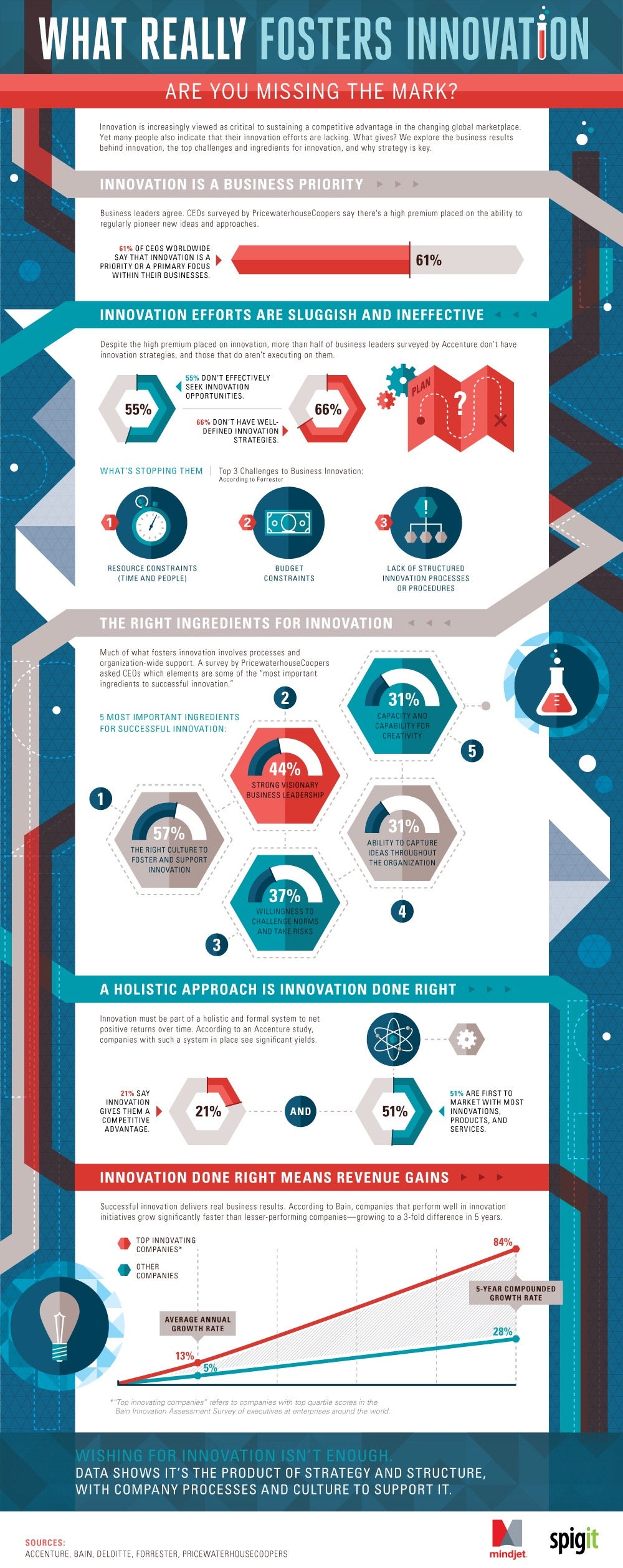
Each company is destined to get the results it gets. What I mean by this is that poor organization, lack of solid and sustainable innovation culture lead to poor results, and more than before, to a company’s trouble or death.A perfect illustration is RIM, which brought the Blackberry to the world in 1999. At that time, BB was a revolutionary product. What happened is that the company lied on its laurels with its BB product, lacked of a clear strategy about where it wanted to take the product. However, according to data compiled by management software company Mindjet, the majority of businesses either don't have effective innovation strategies or don't effectively seek opportunities to innovate.
Smart business leaders shape the culture of their company to drive innovation. Success and constant positive results come from the implementation and execution of strategies, business models, structure, processes, technologies and incentive systems that encourage innovation.

1- Define your company’s mission around innovation. Many companies don’t have a mission statement, but for those which do, often times statements use generic terms, such as “best product in the world”, “best customer service”… They do not inspire employees to innovate. A strong and inspiring vision should be framed around how the company works to change its customer’s world, for the better.
For instance, Amazon’s mission is "Our [Amazon's] vision is to be earth's most customer centric company; to build a place where people can come to find and discover anything they might want to buy online."
Coca Cola’s mission is to “refresh the world, inspire moments of optimism and happiness, create value and make a difference”. 

You build an innovation capability by changing your culture, which requires a lot of hard work. You only see the results of this hard work over time.

2- Create the structure to allow employees to experiment new ideas with unstructured time. Successful innovative companies give time to their employees to get away from their daily tasks, to work on personal or company projects not directly related to their work. Then tap into this creative process.Google is well known in the tech community for its "20% time," which gives employees a day a week to follow their passions, but it's hardly the first company to have done so. For decades, 3M Corp. has allotted 15% of its employees' time to innovation, which led to the creation of the now-ubiquitous yellow sticky note, among other products. When innovation gets postponed for too long, companies languish -- witness the reversal of RIM's fortune and Microsoft's vilification in the mainstream media for its failure to innovate. "Innovation programs remove the constraints that accompany traditional work, and offer a safe space for failure. That lets people try riskier things.", says Dan Pink, author of the best-selling book Drive: The Surprising Truth About What Motivates Us.Seeing innovation as idea management is much more effective than seeing it as just commercialization. In the commercialization view, the only way to win is to have a great idea, protect the IP from it, and bring it to market. In the idea management view, you win by identifying and executing great ideas. They don’t have to be new products; the ideas can be for new ways of doing things, or for new business models. Those are all ideas. The innovation process needs to manage ideas – not just create new products.

Reward employees with time to think, while providing them with the structure they need
.

3- Recognize employees’s contribution to the innovation process.  Some companies offer monetized incentives. In mine opinion, it is hard to assign a $ value to innovation; this is good for sales teams. Some companies give annual innovation awards; it is a good initiative for a short term, but it creates more competition than it encourages collaboration and creates emulation. My former employer set up a more robust recognition program (it was around good performance, not innovation, but it can be applied to innovation stimulation). It is a peer-based recognition program where employees could purchase a “fuzzy” for 50 cents (profits went to a pool for charity donations), and would give the fuzzy to a co-worker to recognize their achievements. “Fuzzies” circulated around the office and stimulated others to do the same.

4- Return to the past. Debra Kaye, author of Red Thread Thinking
, advises companies to return to the past. No new idea is completely original. Some concepts may not have materialized for various reasons, but it is always good to look at the past and understand why it did not work out. You avoid future mistakes, you can find ways to better the products (new technology, new process, new skill…). Start-up companies which by definition don’t have a past can look at what’s be done in the industry, what did not find success, and bounce off this to create something new.

5- Debra Kaye also stresses that companies should pay attention to culture, not trends. Culture is mass ideology - a system of values and beliefs that runs so deep we don't question it. There's an American belief in personal invention and reinvention. You see that in social products like Snapchat and Instagram, which allow us to invent ourselves in the moment. They may seem like a trend. But they reflect a deep underlying value.
Trends are much more superficial. They are hard to get in and out of quickly enough to make money. Kraft came out with CarbWells in 2004, at the end of the low-carb craze. It was a disaster.

6- Continuous education (L&L, conferences, seminars…). Self-development is the key to employee’s success. In the same system where company should create a structure for unstructured time, those same companies should create time for continuous education. Allow employees to seek new interests, learn and develop new skills.

7- Allow failure. The essence of innovation is that it takes multiple experiments to successfully create new products, solutions, services.  Failure is part of the innovation process. When employees are not afraid of failure, they will feel empowered to take risks and be “crazy”.

What reasons do you see for innovation to succeed?  Share your stories.